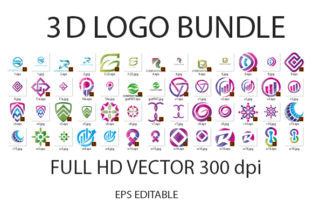
25 Logo Abstract 3D: Integrating High-Resolution Assets into Professional Design Workflows
In the modern digital landscape, visual identity is no longer just about static shapes or flat typography. It is about depth, dimension, and the ability to convey a brand's complexity through three-dimensional space. This is where 25 Logo Abstract 3D becomes a critical asset for professionals seeking to elevate their creative output. These assets represent more than just a collection of images; they are a toolkit designed to streamline the initial phases of branding projects while maintaining high standards of quality and editability.
The core value of this specific set lies in its dual format availability. Each of the 25 abstract concepts is provided in both EPS and JPG formats, catering to different stages of the design lifecycle. The EPS files serve as the foundation for vector-based workflows, allowing designers to manipulate paths, adjust colors, and scale elements without any loss of fidelity. Meanwhile, the high-definition JPG files provide immediate visual references that are perfect for client presentations, mood boards, or quick mockups before committing to the heavy lifting of vector editing.
Strategic Placement in the Creative Process
Understanding when to introduce these assets into your workflow is just as important as knowing how to use them. 25 Logo Abstract 3D fits naturally into the early discovery and conceptualization phases of a project. When a client approaches you with a vague idea—perhaps describing a need for something "modern," "dynamic," or "tech-forward"—you often face the challenge of translating abstract words into concrete visuals. Instead of starting from a blank canvas, which can be time-consuming and prone to creative blocks, these 3D abstract logos offer a curated starting point.
During the planning stage, you can utilize the JPG previews to present multiple directions to stakeholders quickly. Because all files are HD at 300dpi, they look crisp on large monitors and print-ready proofs alike. This allows for informed decision-making early on, ensuring that the chosen direction aligns with the client's vision before significant resources are spent on finalizing the design. Once a concept is selected, the transition to the EPS file ensures that the design remains editable for future iterations, marketing materials, or rebranding efforts down the line.
Integration with Existing Design Ecosystems
Professional workflows rarely exist in isolation. They involve a complex interplay between various software tools, cloud storage solutions, and collaborative platforms. The versatility of 25 Logo Abstract 3D ensures it integrates seamlessly with industry-standard applications like Adobe Illustrator, CorelDRAW, and Affinity Designer. The EPS format is universally recognized by these vector programs, making the import process straightforward and reliable.
For teams working remotely, the organization of these assets is paramount. Since each logo is available in two distinct formats, establishing a consistent folder structure is essential for efficiency. A recommended approach involves creating a primary directory for the project, subdivided into "Concepts," "Vector Sources," and "Presentation Assets." By placing the JPGs in the presentation folder and the EPS files in the source folder, you maintain a clean environment that reduces the risk of version control errors. This discipline is crucial for freelancers managing multiple clients simultaneously, as it prevents the confusion of mixing up final deliverables with raw assets.
Technical Considerations for Implementation
While the visual appeal of 3D abstract logos is evident, the technical specifications determine their long-term utility. The mention of 300dpi resolution in the JPG files might initially seem contradictory to vector graphics, but it serves a specific purpose in hybrid workflows. High-resolution raster images are indispensable for texture mapping, lighting effects, and creating realistic renders that cannot be achieved with pure vectors alone. However, the inclusion of the editable EPS file bridges the gap, allowing you to strip away the raster components if a flat, scalable vector solution is required for web use or large-format printing.
When preparing these files for production, attention must be paid to color profiles and layer management. Before importing an EPS file into your project, always verify the color mode. If the original file is in CMYK, it is optimized for print, whereas RGB versions are better suited for digital screens. Editing the file to ensure consistency with your brand guidelines is a necessary step. This might involve ungrouping layers, simplifying complex path structures to improve performance, or adjusting gradients to match a specific palette. The fact that the files are fully editable means you have the freedom to deconstruct the abstract forms and rebuild them to fit unique brand narratives.
Optimizing for Cross-Platform Consistency
One of the most common challenges in branding is maintaining consistency across diverse media channels. A logo that looks impressive on a billboard may lose its impact when shrunk down for a mobile app icon or a social media avatar. The 3D nature of 25 Logo Abstract 3D requires careful consideration during the adaptation phase. Deep shadows and intricate details that work well in a high-resolution JPG might disappear when scaled down.
To address this, use the EPS files to create simplified variations. You can isolate the core geometric shapes from the 3D shading effects to create a monochromatic version suitable for single-color applications like embossing, faxes, or wireframe coding. This process of abstraction ensures that the brand remains recognizable regardless of the medium. Furthermore, because the source files are editable, you can experiment with different lighting angles within the 3D models to see how the logo behaves under various environmental conditions, ensuring robustness before final delivery.
Efficiency and Quality Control in Business Workflows
For entrepreneurs and small business owners, time is a finite resource. Utilizing pre-designed, high-quality assets like 25 Logo Abstract 3D can significantly reduce the turnaround time for launching a new brand identity. Instead of spending weeks commissioning custom illustrations or struggling with amateur design software, professionals can leverage these assets to jumpstart their visual strategy. This efficiency allows more time to focus on other critical aspects of the business, such as market research, customer acquisition, and product development.
Quality control is another factor where these assets shine. The requirement for HD 300dpi files indicates a commitment to professional standards. In a workflow where a client might request last-minute changes or additional formats, having access to high-resolution sources prevents the degradation of image quality that often occurs with low-res downloads. This reliability builds trust between the service provider and the client, reinforcing the perception of professionalism and competence.
Moreover, the flexibility of these files supports long-term scalability. As a business grows, its visual identity may need to evolve. Perhaps the company expands into new markets, requiring a more global aesthetic, or perhaps the brand pivots to a more minimalist approach. Having the original editable EPS files means you are not locked into a single look. You can revisit the 25 abstract concepts years later, modify the 3D geometry, update the textures, and refresh the brand without needing to start the design process from scratch. This longevity adds tangible value to the initial investment in the asset pack.
Collaborative Dynamics and Asset Sharing
In team environments, the ability to share and collaborate on design assets is vital. The combination of JPG and EPS formats facilitates smooth collaboration between graphic designers, copywriters, and marketing managers. Non-designers can review the JPGs in standard image viewers or web browsers without needing specialized software, providing feedback on the overall look and feel. Once feedback is incorporated, the designer can open the corresponding EPS file to implement the changes precisely.
This separation of concerns streamlines communication. It eliminates the frustration of non-designers trying to edit vector files or designers waiting for clients to understand why a low-resolution image won't suffice for a specific application. By clearly defining the role of each file type within the workflow, teams can operate more cohesively. The 25 Logo Abstract 3D collection acts as a universal language, providing a shared visual reference that aligns everyone involved in the project toward a common goal.
Maximizing Value Through Adaptation
The true power of these assets lies not just in their appearance, but in their adaptability. Whether you are a marketer creating a campaign, an educator designing course materials, or a hobbyist building a personal portfolio, the principles of integration remain the same. The key is to view these 3D logos not as finished products, but as raw materials for your own creativity. Use them to inspire your own designs, combine them with other elements, or deconstruct them to understand the underlying geometry of effective 3D branding.
By treating 25 Logo Abstract 3D as a foundational component of your workflow rather than a shortcut, you unlock its full potential. The ability to edit the files ensures that every project remains unique, even when using the same base assets. This balance between efficiency and customization is what defines successful modern design practices. It allows professionals to deliver high-quality, tailored results rapidly, meeting the demands of today's fast-paced digital economy while maintaining the integrity and depth of their visual storytelling.
Ultimately, the integration of these assets into your routine represents a shift towards smarter, more strategic work. It acknowledges that in a world saturated with information, the brands that stand out are those that can communicate their essence clearly and effectively. With the right tools and a disciplined approach to implementation, 25 Logo Abstract 3D provides the structural support needed to build compelling, enduring brand identities.