Isometric 3d Rural Landscape: Visualizing the Heart of Agriculture and Country Living
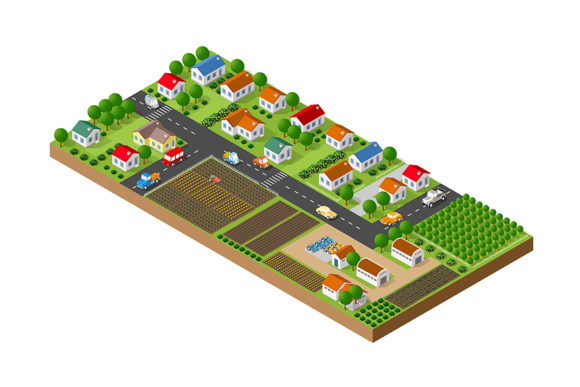
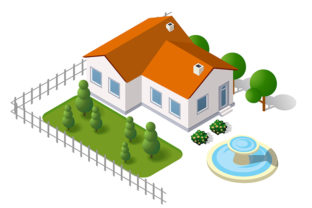
When you first encounter an isometric 3d rural landscape, it often feels like peering into a perfectly organized world where every blade of grass, barn door, and tractor tire is placed with deliberate precision. Unlike standard perspective views that distort distances to mimic human vision, this specific style uses parallel lines to create a unique, pseudo-3D effect. The result is a flat yet dimensional illustration that captures the essence of farming, countryside life, and agricultural industry without the visual clutter of deep depth perception.
This isn't just about making things look cute or cartoonish; it is a powerful communication tool used by designers, developers, and business owners who need to convey complex spatial relationships clearly. Whether you are looking at a tree house farmhouse perched on a hill or a detailed harvester working through a golden field, the isometry allows you to see the layout of the entire operation at a glance. It transforms a chaotic scene of nature and machinery into a clean, understandable graphic element that tells a story instantly.
Why This Style Dominates Modern Digital Design
The appeal of the isometric 3d rural landscape lies in its ability to simplify reality. In the real world, a farm is a sprawling mix of overlapping trees, winding roads, and scattered buildings. Trying to explain the flow of traffic or the layout of crops in a photograph can be confusing. However, when those elements are converted into an isometric icon or a full landscape illustration, the relationships become obvious. You can immediately see how the barn connects to the field, where the green garden sits relative to the house, and how the tractor moves through the crop.
This clarity makes it incredibly valuable for anyone involved in agriculture, rural development, or eco-tourism. Imagine trying to pitch a new sustainable farming initiative to investors. A traditional photo might show muddy boots and overgrown weeds, but an isolated isometric 3d rural landscape highlights the efficiency of the system. It showcases the cultivated land, the fresh produce, and the modern equipment in a way that feels optimistic and forward-thinking. The flat color palette often associated with these designs ensures that the focus remains on the structure and function rather than distracting lighting effects.
Real-World Applications Across Industries
The versatility of these illustrations extends far beyond simple decoration. Different sectors have found unique ways to integrate rural landscape concepts into their workflows and marketing strategies.
- Gaming and Interactive Experiences: Many strategy games and simulation apps rely heavily on isometric views. Players managing a virtual farm need to understand the placement of their buildings, tools, and crops. An illustration set featuring a village, construction sites, and nature elements provides the necessary visual language for users to navigate their digital homesteads intuitively.
- Agricultural Technology (AgTech): Companies developing software for modern farming use graphic interfaces that mirror physical fields. When an app displays data about soil health or crop yield, overlaying an isometric 3d rural landscape helps farmers visualize exactly which section of their property needs attention. The set of elements—from flower patches to vegetable rows—acts as a map that is both functional and engaging.
- E-commerce and Branding: Brands selling organic products, seeds, or country lifestyle goods often use these visuals to evoke a sense of authenticity. A clipart collection showing a harvester or a sign for a local market adds a touch of rustic charm to a website. It signals to the customer that the product is natural, domestic, and grown with care.
- Education and Planning: For urban planners or agricultural students, understanding the scale of rural infrastructure is crucial. A plan view created with 3d building models allows for easy analysis of space utilization. Students can learn about the logistics of moving from planting to harvest without needing to visit a physical site.
Choosing the Right Elements for Your Project
If you are considering incorporating an isometric 3d rural landscape into your work, it is important to think about the narrative you want to tell. Not all farms look the same, and the details matter. Are you focusing on the industry aspect, highlighting heavy machinery and large-scale production? Or are you leaning towards the home and garden side, emphasizing the tree house, the greenery, and the peaceful outdoor atmosphere?
The choice between a cartoon style and a more realistic color scheme will also dictate the tone. A bright, colorful icon set works wonders for mobile apps targeting younger audiences or educational tools. In contrast, a muted, earthy palette might be better suited for a corporate report on sustainability or a high-end real estate listing for a country estate.
One common consideration is the level of detail. While a single element like a tractor is simple to render, a full collection including fields, trees, houses, and equipment requires careful balancing. If the design is too busy, it loses the clean aesthetic that makes isometry so effective. Conversely, if it is too sparse, it may fail to convey the richness of the nature and agriculture themes.
Strengths and Limitations to Keep in Mind
The primary strength of using an isometric 3d rural landscape is its scalability and adaptability. Because the objects are constructed on a grid, they can be resized without losing quality, making them perfect for responsive web design. Whether the image appears on a smartphone screen or a large billboard, the layout remains consistent. Furthermore, the isolated nature of these assets means they can be easily extracted from a background and placed onto any color or texture, giving designers total creative control.
However, there are limitations to consider. The flat perspective does not always translate well to representing emotional nuance or dramatic weather conditions. A storm rolling over a field or the golden hour light hitting a barn is harder to capture in a strict isometry compared to a photograph. Additionally, because these images are stylized, they may not be suitable for contexts requiring absolute photographic realism, such as legal documentation or forensic analysis.
Another factor is the cultural context. A rural landscape designed for a North American audience might feature a red barn and a cornfield, while one for a European context might include stone cottages and vineyards. Ensuring the concept aligns with the target audience's expectations is vital for the design to resonate effectively.
Making the Most of Your Visual Assets
To truly leverage the power of these graphics, treat them as more than just pictures. Use them to guide the user's eye through a process. For example, in a step-by-step guide on starting a business related to farming, you could use a sequence of isometric illustrations showing the progression from clearing land to planting seeds, growing crops, and finally harvesting with a machine. This visual storytelling approach keeps the reader engaged and helps them retain information better than text alone.
When selecting assets, look for a cohesive set. Mixing different art styles can break the immersion. Ensure that the tree heights match the building scales and that the road widths are consistent throughout the landscape. Consistency builds trust and professionalism.
Ultimately, the isometric 3d rural landscape is a bridge between the complexity of the agricultural world and the simplicity of digital communication. It takes the rugged reality of country life—the dirt, the work, the nature—and refines it into something accessible and beautiful. Whether you are designing a game, launching a brand, or planning a community project, these visuals offer a fresh, clear perspective that speaks directly to the heart of the countryside.